
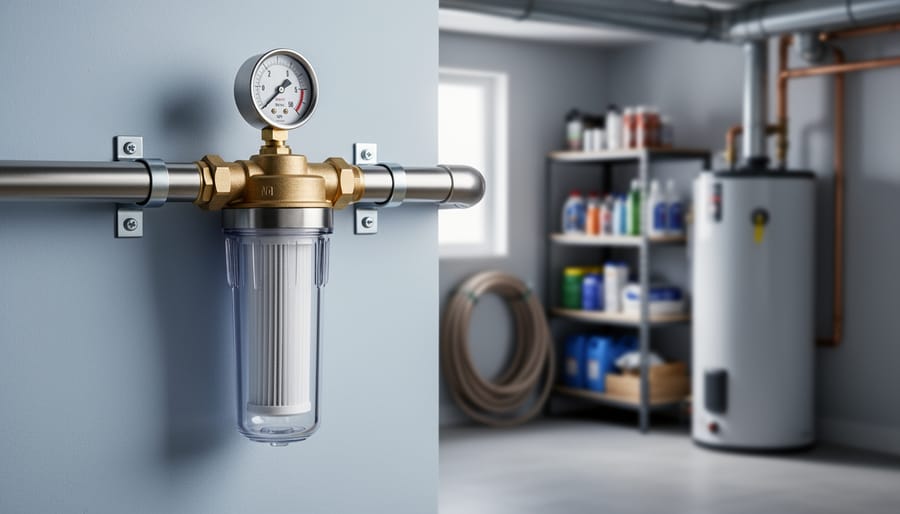
A whole house water filtration system filters every drop of water entering your home through a single point-of-entry unit, delivering clean water to every faucet, shower, and appliance. These systems typically cost between $1,129 and $3,541 for equipment, with installation averaging around $2,274 (though it can range from $200 to $6,000 depending on your home’s configuration and the complexity of the system you choose).
For families building their dream home, integrating a comprehensive water filtration system from the start offers a unique advantage. You’re not retrofitting around existing plumbing or compromising on capacity. Instead, you can select a tailored solution that matches your household size, local water quality concerns, and long-term budget.
The decision feels overwhelming at first. You’ll encounter terms like reverse osmosis, carbon filtration, and UV purification. Equipment costs vary widely, from $80 basic sediment filters to $1,100 multi-stage systems with 1,000,000-gallon capacity. Installation quotes will differ based on whether you’re tying into new construction or modifying an existing main line.
But here’s what matters: choosing the right system means understanding what’s actually in your water, how much filtration your family needs, and which technologies address your specific concerns. NSF-certified systems offer verified performance and safety standards, giving you confidence that your investment delivers results.
This guide breaks down everything you need to know, from comparing filtration technologies to avoiding common purchasing mistakes, so you can make an informed choice that protects your family and enhances your custom home for years to come.
Why Whole House Water Filtration Matters for Your Custom Home
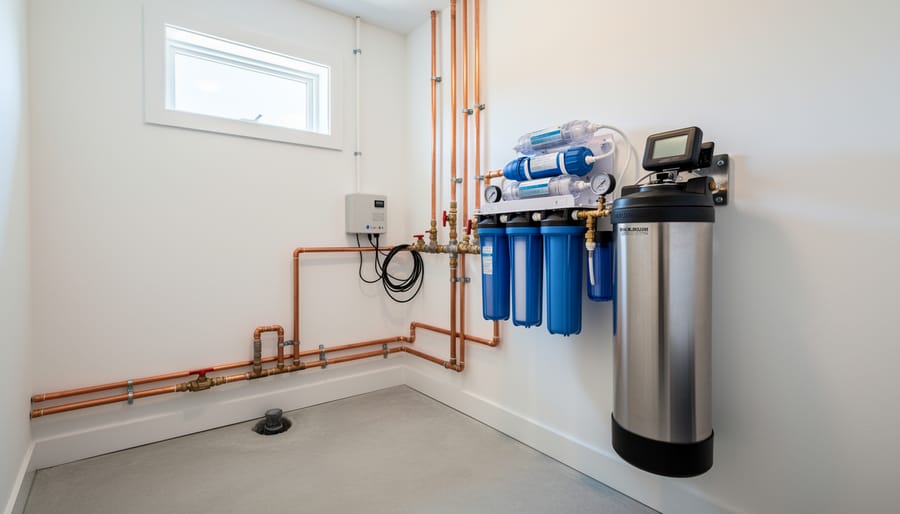
Filtering your water at the point of entry protects every fixture, appliance, and tap in your home. This comprehensive approach means the water flowing to your showers, washing machine, dishwasher, and drinking faucets all receives the same level of treatment. Individual filters at select faucets leave most of your home unprotected, exposing your family and your investment to the same contaminants you’re trying to avoid.
The impact on your home’s systems extends far beyond drinking water. Sediment, minerals, and chemicals in unfiltered water accelerate wear on appliances like water heaters, washing machines, and dishwashers. They also contribute to scale buildup in pipes, reducing water pressure and eventually requiring costly repairs. A whole house system acts as a frontline defense, removing these elements before they can damage your plumbing infrastructure or shorten the lifespan of expensive appliances.
For families, the health considerations reach every corner of daily life. Showering in filtered water means reducing exposure to chlorine and other chemicals that can irritate skin and respiratory systems. Children bathing in clean water, clothes washed without harsh contaminants, and cooking with treated water all contribute to a healthier living environment. You’re not just filtering drinking water, you’re creating a space where water quality supports your family’s wellbeing throughout the day.
Planning for filtration during your custom home build offers distinct advantages. Your builder can integrate the system into your design from the start, selecting optimal placement, ensuring adequate space for the equipment and maintenance access, and coordinating installation alongside other plumbing work. This eliminates the need to retrofit later, when access may be limited and installation costs higher.
Incorporating whole house filtration reflects the same attention to detail that shapes every aspect of your custom home. It’s about building a residence that supports your family’s needs comprehensively, where quality isn’t limited to visible finishes but extends to the fundamental systems that make your house function as a healthy, personalized living space.
What to Look for When Choosing Your System
Choosing the right filtration system means looking beyond marketing promises to the practical factors that will determine how well it serves your family for years to come. Start with an honest assessment of your household’s water usage. A family of two has different needs than a household of six, and your system’s capacity must keep pace during peak demand times like morning routines when showers, laundry, and cooking all happen at once.
Getting your water tested is the single most valuable step you can take. Municipal water reports provide a starting point, but they don’t reflect what’s happening in your pipes or what contaminants might be leaching from your plumbing. An independent water test reveals exactly what you’re dealing with, whether that’s sediment, chlorine, heavy metals, or hardness minerals. This information shapes every other decision you’ll make about filtration.
Flow rate requirements matter more than many homeowners realize. Your system needs to deliver enough filtered water to maintain comfortable water pressure throughout your home, even when multiple fixtures run simultaneously. A system that struggles to keep up will leave someone with a weak shower while the dishwasher runs downstairs. Most homes need a minimum flow rate of 10 to 15 gallons per minute to avoid pressure drops.
Before you commit to any system, evaluate these essential factors:
- Filtration capacity, how many gallons the system can treat before filters need replacement, with some high-capacity systems handling up to 1,000,000 gallons
- NSF certification status, whether the system has been independently tested and verified for safety and performance claims
- Filter replacement frequency and cost, how often you’ll need to change filters and what that will cost annually
- Installation requirements, whether the system works with your home’s plumbing layout and available space
- Warranty coverage, what’s protected and for how long, which signals manufacturer confidence
Maintenance demands vary dramatically between systems. Some require monthly attention while others run for months between filter changes. Think realistically about your willingness to stay on top of maintenance schedules. A sophisticated system that gets neglected will perform worse than a simpler one that receives proper care.
Long-term operating costs often exceed the initial purchase price over a system’s lifespan. Factor in filter replacements, electricity for UV systems, salt for softeners, and any professional servicing. A system that costs more upfront but has lower operating expenses might be the smarter investment for your family’s budget. This holistic view of costs helps you choose a solution that fits your custom home plans without creating ongoing financial strain.
Types of Whole House Water Filtration Systems Compared
Understanding the different types of filtration systems available helps you make an informed choice that addresses your specific water quality concerns. Each system targets particular contaminants, and many homeowners combine multiple technologies for comprehensive protection.
Sediment Filters serve as your first line of defense, capturing particles like sand, dirt, rust, and silt before they enter your plumbing. These mechanical filters use pleated polyester or spun polypropylene media to trap debris down to 5 microns. They’re essential for protecting downstream equipment and appliances, particularly if your water source is a well or if your municipal supply has aging infrastructure. While sediment filters excel at removing visible particles, they don’t address chemical contaminants or microorganisms.
Carbon Filtration Systems tackle taste, odor, and chemical issues through activated carbon media that attracts and holds contaminants like chlorine, volatile organic compounds, pesticides, and industrial solvents. The carbon’s porous structure provides massive surface area for chemical absorption. These systems significantly improve water palatability and remove many concerning chemicals, but they require regular filter changes and don’t soften hard water or eliminate bacteria. Carbon filters work beautifully for municipal water that’s already treated but tastes unpleasant or has chlorine odor.
Water Softeners address mineral content rather than filtration, using ion exchange to replace calcium and magnesium with sodium ions. If your area has hard water, a softener prevents scale buildup in pipes and appliances, extends equipment life, and makes soap work more effectively. However, softeners add sodium to your water and don’t remove contaminants, so they’re typically paired with other filtration methods.
| System Type | What It Removes | Best For | Key Consideration |
|---|---|---|---|
| Sediment Filter | Dirt, rust, sand, particles | Well water, pre-filtration protection | First defense for any system |
| Carbon Filter | Chlorine, VOCs, odors, taste issues | Municipal water, chemical concerns | Requires regular replacement |
| Water Softener | Calcium, magnesium (hardness) | Hard water areas | Adds sodium, needs salt refills |
| UV Purification | Bacteria, viruses, parasites | Well water, microbiological safety | No chemical removal |
| Reverse Osmosis | Heavy metals, fluoride, TDS | Comprehensive purification needs | Reduces flow rate significantly |
UV Purification Systems use ultraviolet light to neutralize bacteria, viruses, and parasites without adding chemicals. The UV wavelength disrupts microorganisms’ DNA, rendering them harmless. These systems are particularly valuable for well water or any source where biological contamination is a concern. UV purifiers require clear water to work effectively, so they’re typically installed after sediment and carbon filters. They need minimal maintenance beyond annual bulb replacement but use electricity and don’t address chemical contaminants.
Reverse Osmosis Systems for whole house applications provide the most thorough purification, forcing water through a semipermeable membrane that blocks contaminants down to 0.0001 microns. RO removes heavy metals, fluoride, dissolved solids, and virtually everything except water molecules. The trade-off is significantly reduced flow rate and substantial water waste, as the system flushes rejected contaminants. Whole house RO is expensive and typically reserved for severe contamination issues or luxury homes where comprehensive purification justifies the investment.
Multi-Stage Filtration Systems combine several technologies in sequence, such as sediment pre-filter, carbon filter, and UV purification. These integrated solutions address multiple water quality issues simultaneously and protect each stage from damage. A multi-stage system with substantial capacity handles comprehensive filtration needs, though upfront costs are higher. The advantage lies in customizing the stages to your specific water quality test results.
Most custom homes benefit from at least a two-stage approach: sediment filtration followed by carbon or UV, depending on whether chemical or biological concerns dominate. Your water test results should guide which technologies you select and in what order to install them.
Understanding Certifications and Performance Standards
When you’re investing thousands of dollars in a whole house filtration system, you need more than marketing promises. NSF International provides independent verification that helps cut through the noise.
NSF tests water filters and treatment systems for safety and performance against rigorous standards. These aren’t manufacturer claims, they’re third-party validations. When you see an NSF certification, it means the system has been tested to remove specific contaminants at verified levels. NSF/ANSI Standard 42 addresses aesthetic effects like chlorine taste and odor. Standard 53 covers health-related contaminants including lead, mercury, and certain pesticides. Standard 58 applies to reverse osmosis systems.
Here’s what matters during your research: a product label that says “NSF certified” isn’t enough. You need to know which specific standards it meets and which contaminants it’s certified to reduce. A carbon filter might carry NSF 42 certification for improving taste but lack NSF 53 certification for removing lead. Both are legitimate certifications, but they address different concerns.
Before you commit to any system, verify the claims. NSF maintains a searchable database of NSF-certified versions where you can look up products by manufacturer and model number. This takes five minutes and prevents costly mistakes. You’ll see exactly what contaminants each certified system removes and to what degree.
Start with water testing to identify your specific contaminants, then match those results to systems with the appropriate NSF certifications. This approach ensures you’re solving your actual water quality issues rather than guessing. When a manufacturer can’t point you to their NSF listing or certification number, that’s your signal to keep looking.
What You Can Expect to Invest
Understanding the financial commitment involved helps you make informed decisions and plan appropriately. The investment in a whole house water filtration system varies significantly based on your needs and preferences.
Equipment costs start at $80 to $250 for basic components, such as single-stage sediment or carbon filters. These entry-level options work well for addressing specific issues in smaller homes. For comprehensive protection, multi-stage filtration systems with 1,000,000 gallon capacity run around $1,100. These higher-capacity units serve larger households and provide multiple stages of treatment for thorough contaminant removal.
Installation represents a substantial portion of your total expense. Professional installation costs average $2,274 but range from as little as $200 for straightforward setups to as much as $6,000 for complex configurations. The wide range reflects factors like system complexity, your home’s plumbing layout, and accessibility of installation points. When you integrate filtration during construction rather than retrofitting later, installation typically falls on the lower end since plumbers can route pipes optimally from the start.
Overall, water treatment systems range from $1,129 to $3,541 on average when combining equipment and installation. Your total cost depends primarily on system type and household size. A family of two with basic filtration needs sits at the lower end, while a larger household requiring multi-stage treatment with softening capabilities approaches the higher range.
Beyond the initial outlay, consider ongoing expenses. Replacement filters typically cost $50 to $300 annually depending on your system and water usage. Annual maintenance, if you hire a professional, adds another $100 to $300. These recurring costs are manageable when you plan ahead.
Smart budgeting means viewing this investment holistically. Quality water filtration extends appliance lifespan, reduces plumbing repairs, and eliminates bottled water expenses. Many families find the long-term savings offset the upfront costs while delivering peace of mind about their water quality.
Our Recommendations for Different Home Situations
Choosing the right whole house filtration system means matching technology to your family’s specific circumstances and priorities. While a professional water test should guide your final decision, understanding which configurations work best for common situations can help you start the conversation with confidence.
Families with Young Children
When you’re building a home where young ones will bathe, drink, and play, multi-stage systems offer the broadest protection. A combination of sediment filtration, activated carbon, and UV purification addresses bacteria, chemicals like chlorine and chloramines, and particulates that affect both health and taste. These systems typically fall in the $1,500 to $3,000 range for equipment and installation, putting comprehensive protection within reach for most custom home budgets. The peace of mind that comes from knowing every tap delivers clean water makes this investment worthwhile for families who prioritize their children’s wellbeing.
Homes in Hard Water Areas
If you’re building in regions with high mineral content, pairing a water softener with a carbon filter creates the ideal setup. The softener handles calcium and magnesium that damage appliances and leave residue, while carbon removes chlorine and improves taste. This combination protects your investment in high-end fixtures and extends the life of water heaters and washing machines. Equipment costs typically range from $1,200 to $2,500, with installation adding another $800 to $1,500 depending on your home’s layout.
Common Scenario Matches
- Budget-conscious builders: Start with a sediment and carbon filter combination ($500 to $900 total), leaving room to add UV or softening later
- Well water homes: Prioritize sediment filtration and UV purification to address bacteria and particulates common in private water sources
- Specific contaminant concerns: Choose NSF-certified systems targeting your water test results, such as reverse osmosis for heavy metals or specialized carbon for PFAS
- Luxury custom projects: Multi-stage systems with 1,000,000 gallon capacity and whole-home softening create spa-quality water at every fixture
- Sensitive skin or allergies: Focus on chlorine and chloramine removal through high-quality carbon filtration
Remember that your ideal system depends on what’s actually in your water supply, not just general recommendations. Request a comprehensive water quality test early in your planning process, then work with a qualified professional to design a solution tailored to your results. At Heartland, we coordinate with water treatment specialists during the design phase to ensure your filtration system integrates seamlessly into your custom home’s infrastructure, making clean water just another thoughtful detail in your dream home.
Common Mistakes to Avoid
Even the most well-intentioned homeowners can stumble when selecting a whole house water filtration system. Understanding these common pitfalls will help you make decisions that serve your family for years to come.
Skipping water testing represents the single biggest mistake. You can’t address problems you haven’t identified. Municipal water quality varies dramatically from one area to another, and well water introduces entirely different concerns. Without professional testing, you’re essentially guessing at which contaminants need removal. This often leads to purchasing systems that filter the wrong things while missing the actual issues in your water supply.
Choosing based solely on price creates problems at both ends of the spectrum. The cheapest option rarely addresses your specific needs and may cost more over time through frequent replacements and ineffective filtration. Conversely, the most expensive system isn’t automatically the best fit for your situation. A $1,100 multi-stage system with 1,000,000 gallon capacity makes sense for some households but represents overkill for others who’d be perfectly served by equipment costing $80 to $250.
Undersizing your system causes frustration daily. When flow rate can’t keep pace with simultaneous water use, someone showering while the dishwasher runs and laundry is going, pressure drops noticeably. Calculate your household’s peak demand realistically, accounting for future needs as your family grows.
Ignoring maintenance requirements sets you up for system failure. Every filtration system needs regular attention, from simple filter changes to more involved servicing. Skipping NSF certification verification means trusting marketing claims without independent proof. NSF tests water filters and treatment systems for safety and performance, providing assurance that NSF-certified versions actually do what manufacturers promise.
Perhaps the costliest mistake is failing to integrate filtration planning into your custom home planning. Retrofitting after construction means higher installation costs, potentially reaching $6,000 versus the $200 to $2,274 average when planned from the start, and compromises on optimal placement. Building filtration into your initial plans eliminates these headaches entirely.
Planning Installation in Your Custom Home Build
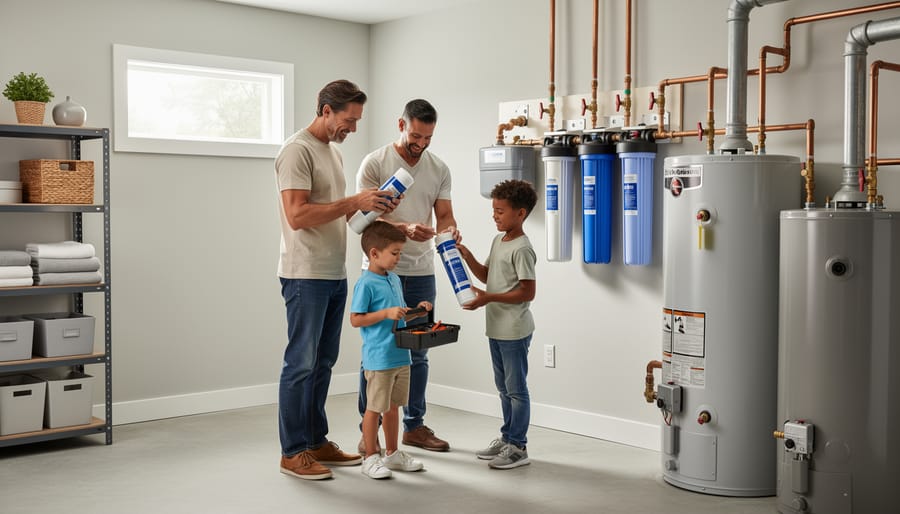
The new construction phase offers a unique window for whole house filtration integration that’s far simpler and more cost-effective than retrofitting an existing home. When you’re building with a custom home builder, the entire plumbing system is exposed and accessible, making installation straightforward and avoiding the need to cut into finished walls or navigate around completed spaces.
Your filtration system belongs at the main water line entry point, after the water meter but before the line splits to serve different areas of your home. This positioning ensures every tap, shower, appliance, and water-using fixture receives filtered water. During construction, your builder can create dedicated space for the system, typically in the basement, garage, or utility room, with proper ventilation, drainage access, and enough clearance for future filter changes and routine home maintenance.
Starting the conversation early matters. Share your water filtration goals during initial design discussions, not weeks before framing completion. Your builder needs to account for the system’s footprint, ensure adequate water pressure throughout the home (systems can reduce pressure by 10 to 15 PSI), and coordinate with plumbers on proper installation sequencing. If you’re considering multiple treatment stages, such as sediment filtration followed by carbon filtering and UV purification, planning ahead allows for logical component placement and efficient service access.
At Heartland Custom Homes, we incorporate water quality solutions into the design process from day one. We work with you to determine the right system for your family’s needs, coordinate with trusted plumbing partners, and ensure your filtration setup integrates seamlessly with your home’s overall design. We’ve learned that addressing water quality during construction rather than as an afterthought creates better outcomes and saves homeowners thousands in installation costs while delivering cleaner water from move-in day forward.
Frequently Asked Questions
How often do I need to replace filters in a whole house system?
Most sediment and carbon filters need replacement every three to six months, depending on your water quality and household usage. Multi-stage systems may have different replacement schedules for each component, so check your manufacturer’s recommendations and keep track of when you installed each filter.
Will a whole house filtration system reduce my water pressure?
A properly sized system should have minimal impact on water pressure. If you notice significant pressure drops, it usually means your filters need replacement or the system wasn’t sized correctly for your household’s flow rate requirements.
Do these systems remove beneficial minerals from drinking water?
Standard carbon and sediment filters preserve beneficial minerals like calcium and magnesium while removing contaminants. Reverse osmosis systems do remove minerals, which is why many homeowners pair them with a remineralization stage or use them only at drinking water taps rather than for the whole house.
How long does a whole house water filtration system typically last?
The main housing and components can last 10 to 15 years or more with proper maintenance. Regular filter replacement is the key to longevity, neglecting this maintenance shortens the system’s lifespan and reduces its effectiveness at protecting your plumbing and appliances.
Beyond these common questions, many homeowners building custom homes wonder about the best time to install their system. The answer is simple: during construction. Planning for whole house filtration from the start allows your builder to position the system optimally, run plumbing efficiently, and integrate it seamlessly into your mechanical room or basement layout. This approach saves you the higher costs and complications of retrofitting later, and it ensures your home’s water quality is protected from day one.
What to Look For
When evaluating whole house water filtration systems during your custom home planning, prioritize these decision factors to find the right match for your family’s needs.
Start with a professional water quality test. You can’t address problems you haven’t identified, and your area’s specific contaminants will dictate which filtration technologies you actually need rather than paying for features that don’t serve you.
Flow rate capacity matters more than most realize. Your system must handle peak demand, multiple showers running while the dishwasher and washing machine operate, without dropping pressure below comfortable levels. Calculate your household’s simultaneous water use to determine the gallons-per-minute rating you’ll need.
Filtration capacity tells you how much water the system can treat before requiring maintenance. A 1,000,000 gallon capacity system, for instance, might serve a family of four for several years before needing filter replacements, reducing long-term hassle and costs.
NSF certification isn’t optional. This independent testing verifies that systems actually remove what they claim to remove. Look for NSF-certified versions specific to your water quality concerns rather than trusting marketing promises alone.
Finally, consider total ownership costs, not just the equipment price. Factor in installation (averaging $2,274), ongoing filter replacements, and annual maintenance when comparing options. The cheapest upfront system often costs more over time.
Choosing a whole house water filtration system is more than a purchasing decision, it’s an investment in your family’s daily health and your home’s long-term value. Clean, filtered water flowing through every tap and appliance protects both the people you love and the infrastructure you’re building to last generations. When you’re creating a custom home from the ground up, incorporating filtration from the start means seamless integration, optimal performance, and one less retrofit down the road.
At Heartland Custom Homes, we believe your dream home deserves attention to every detail, from the foundation to the fixtures. Water quality isn’t just a technical specification, it’s part of creating a living environment tailored to your family’s unique needs and priorities. We’ve seen firsthand how homeowners who plan for whole house filtration during the design phase end up with cleaner solutions, lower costs, and greater peace of mind.
The best time to discuss filtration options is early in your custom home planning process, when we can thoughtfully integrate the system into your layout and budget. Let’s talk about how clean water throughout your entire home can be part of the personalized, family-focused space you’re building.